
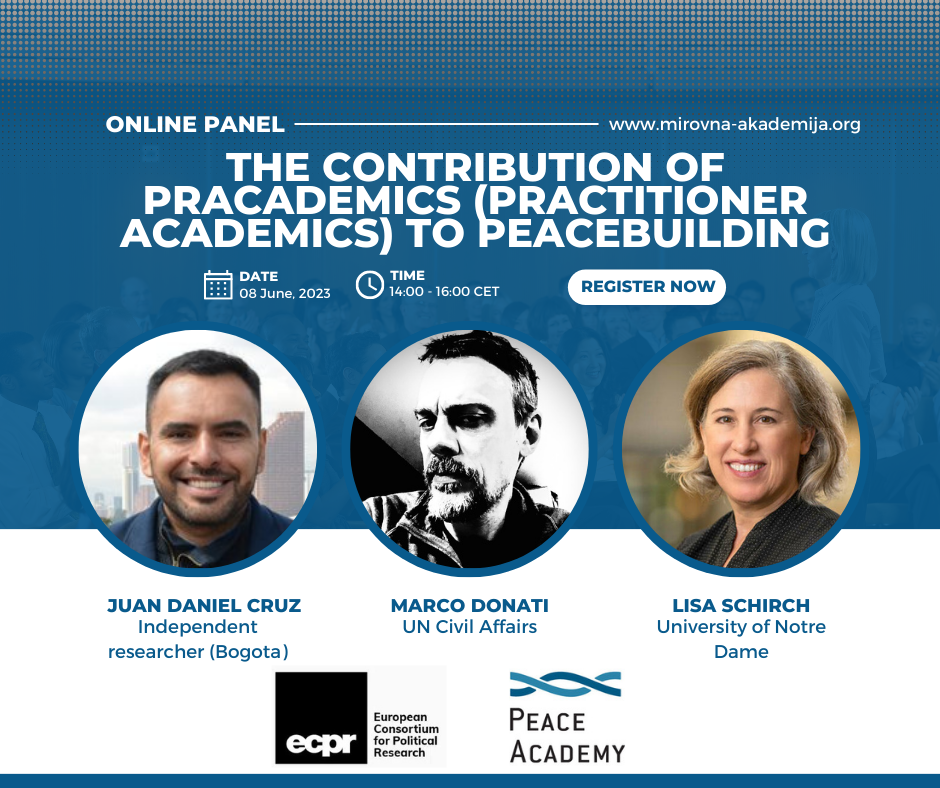
The Contribution of Pracademics (Practitioner Academics) to Peacebuilding
As societies continue to fracture along political, ethnic, and ideological lines, becoming aware of and being equipped to deal with various types of trauma is increasingly relevant for all of us in our families, everyday relationships, workplaces, and communities. Trauma-sensitive peacebuilding requires that we recognize and acknowledge how individual, communal, and historical harms are root causes of communal divisions. By cultivating our sensitivity to harm and incorporating trauma healing approaches in our relationships and work, we are better equipped as peacebuilders in our interpersonal and intergroup relationships.
It is our pleasure to inform you that the Peace Academy is offering the course entitled Building Environmental Movements in Divided Societies. The course will offer an excellent opportunity for learning about the emergence and development of environmental movements and mobilization for spatial justice and collective action. This course will be offered as an online course where the participants will have the opportunity to attend the course remotely via the Zoom platform.
The recent years have seen an unprecedented wave of mobilization around spatial and environmental-related issues. Environmental campaigning and ecological concerns have brought together different actors to stage protests and raise their voice for a better environment and the preservation of natural resources. Collective action for the environment has occurred also in societies divided along ethnic lines, where individuals of different background joined their forces to safeguard natural resources. This course aims to provide students with a critical reading of the main debates within the field of collective action in divided societies. It draws on the literature on social movement studies and on deeply divided societies, with the contribution of scholars, local practitioners and activists engaged in the field inside and outside the region. Bosnia and Herzegovina constitutes a case in point for the study of social movements in divided societies, and in particular of environmental movements, which emerged and diffused nationwide in the last decade. The country represents in fact a critical and strategic case for the examination and understanding of the dynamics of mobilization in divided societies, at times challenging the existing theoretical assumptions, since over the last decade contentious collective action took place in spite of the country presenting a wide range of unfavourable conditions for its occurrence.
 Beskrajno smo tužni zbog vijesti da je nas kolega, dugogodišnji predavač na Ljetnoj Mirovnoj akademiji i prijatelj, Tonči Kuzmanić, preminuo.
Zauvijek ćeš biti u našim srcima i radu brojnih učesnika i učesnica koje je tvoj rad neumitno inspirisao i usmjerio. „Mislimo nemilosrdno!“
Tim Mirovne akademije
Autorica: Zlatiborka Popov Momčinović, Sarajevo, BiH Moć je opšte mesto političke teorije i sociologije kao, kako se navodi, fundamentalne društvene nauke. Zdravorazumski gledano, moć leži u rukama onih...
Autorica: Melina SadikovićDa li je u životu sve saopćivo ili ljude spaja samo muk?Tin UjevićGodina 2010 je izborna godina. Tako je Bosna i Hercegovina, u septembru 2010. godine, mjesto gdje bi...
Autor: Zoran Tihomirović (Zagreb, Hrvatska) Ako tvrdimo kako ne posjedujemo dovoljno oblika moći ili dovoljno odgovarajućih oblika moći, dovodimo u pitanje temeljnu svrhu političkog sustava. Ono što...
Autorica: Mirjana Mikić Zeitoun Uvod: (Obzirom da sam, kako to već svi moji prijatelji i poznanici dobro znaju, jako vezana za svoju obitelj, a slijedom posla koji dugo radim, i volim, dosta...